Plan the next buying step
Check the current destination route before ordering. This earlier article provides background. For a China-market EV, use Egypt EV import requirements and its official references; confirm the actual importer, vehicle age, steering, powertrain and approval route with the destination agent.
Keep the shipment scope explicit with the customs clearance and vehicle approval checklist. Have the destination assess the actual vehicle specification and approval route separately from customs release before scheduling road use.
Request a destination-specific sourcing and shipping quotation with the product identity, quantity and delivery scope.
Egypt is one of the continent’s biggest car importers and a fast-growing market for new energy and affordable cars. Thanks to its strategic location global trade agreement, as well as a strong demand for mid-level passenger cars, Egypt has become a prime transhipment market for the Chinese car exporters. But the Egyptian customs is complicated and there is a lot of documentation to be done, as import rules in the country change so does the document requirements. This guide covers all aspects of the clearance process and provides practical advice to help your shipment clear smoothly and avoid any delays or fines.
Why Target the Egyptian Market?
Large import volume: Egypt has a well-developed vehicle import market, especially for compact sedans and fuel-efficient hybrids.
Government support: In recent years, Egypt has encouraged the import of new vehicles and components to modernize its fleet and reduce emissions.
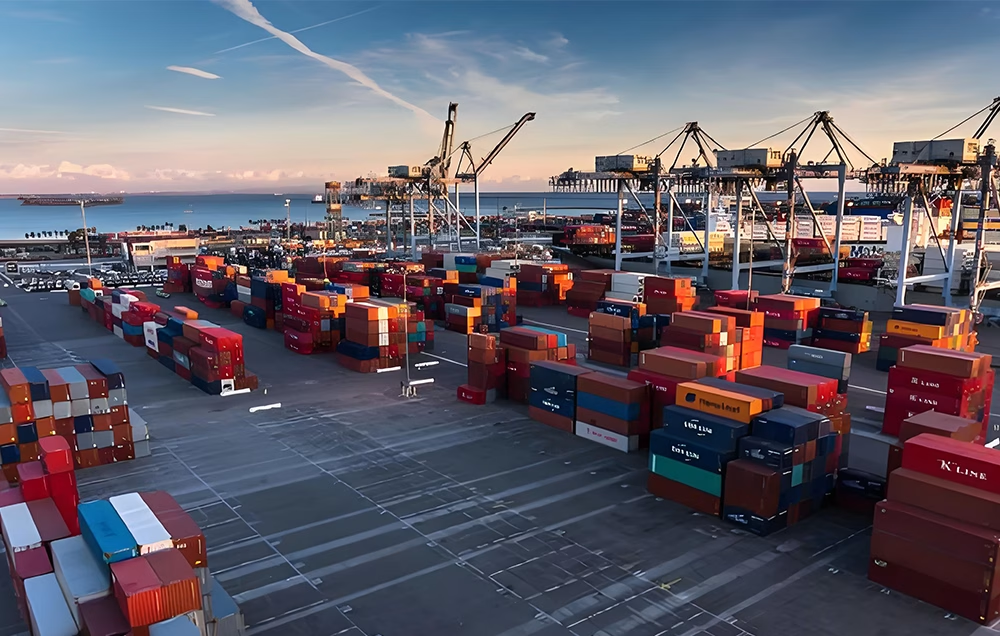
Strategic trade location: Ports like Alexandria and Port Said serve as key entry points for automotive imports from Asia.
1. Required Documents for Vehicle Export to Egypt
Before shipping, Chinese exporters must prepare a complete set of documents in English or Arabic. Many of these require notarization or embassy/legal certification.
Mandatory Documents:
Commercial Invoice: Must include detailed descriptions, VIN, engine number, HS code, unit and total value.
Certificate of Origin (COO): Must be certified by the China Council for the Promotion of International Trade (CCPIT).
Packing List
HS Code Confirmation: Accurate classification affects the applicable duty rate.
Technical Specifications Sheet: Including VIN, engine number, fuel type, dimensions, and powertrain configuration.
Bill of Lading (B/L): Issued after cargo is loaded onto the ship.
Import Permit: Required for some vehicle categories (especially commercial or high-displacement models).
Note: Most documents must be legalized by the Egyptian Embassy or Consulate in China before shipment.
2. Export Declaration and Shipping from China
Once documentation is complete, the exporter must:
Book container shipping: FCL (Full Container Load) is recommended for security and reduced damage.
Submit export declaration: Including conformity certificates, VIN information, and CIQ (when applicable).
Port loading and sealing: Vehicles are loaded at major Chinese ports such as Shanghai, Ningbo, or Tianjin.
Ocean freight: Transit time to Alexandria or Port Said is approximately 20–28 days.
For new energy vehicles, exporters like Auto From China can include DC chargers or adapt the charging ports (GBT to CCS2) to match regional infrastructure.
3. Customs Clearance in Egypt
Upon vessel arrival at Egyptian ports (typically Alexandria, Port Said, or Damietta), the local importer must complete the following clearance process:
Step-by-Step Process:
Pre-Registration via Nafeza
All vehicle details must be submitted through the Egyptian customs digital platform Nafeza before arrival.
Customs Documentation Submission
All notarized and certified documents must be uploaded or submitted physically.
Customs Valuation and Tax Assessment
Based on CIF (Cost + Insurance + Freight) price.
Duties and taxes:
Import Duty: 5% to 40% (depending on engine displacement, fuel type, and category)
VAT: 14% flat
Additional Fees: May include statistical tax, development fees, or environmental surcharges
Physical Inspection
Customs officers may verify:
VIN and engine number
Conformity with declared specs
Emission or roadworthiness compliance
Delays may occur if discrepancies are found.
Container Release
After successful inspection and tax payment, the importer receives release documentation to pick up the container.
It’s advisable to clear the vehicle promptly to avoid demurrage charges or storage penalties.
4. Best Practices & Risk Mitigation
Tips for Smooth Clearance:
Use new vehicles: Egypt restricts used car imports except under limited circumstances.
Double-check HS Code classification: Misclassification can result in incorrect duty rates or rejection.
Work with certified local customs agents: Choose agents with AEO (Authorized Economic Operator) status or proven port experience.
Translate and notarize documents properly: All Arabic translations must be professionally certified and stamped.
Choose trusted logistics partners: A reliable forwarder ensures timely booking and cargo tracking.
Auto From China: Your Strategic Partner for Exporting to Egypt
At Auto From China, we offer comprehensive vehicle export solutions tailored for North African markets like Egypt.
Our services include:
End-to-end document handling
Pre-shipment inspection coordination
Dual-language labeling (VIN, engine info in Arabic + English)
Charging port conversions (for NEVs)
Fast logistics via FCL to Alexandria and Port Said
After-sales parts and support for importers and dealers
Whether you’re sourcing Toyota Corolla Hybrid, BYD Qin Plus, Aion Y Plus, or affordable small sedans for fleet sales, we help Egyptian partners achieve smooth customs clearance and optimized delivery timelines.
Ready to Export Cars from China to Egypt?
Let us help you navigate Egypt’s customs requirements and simplify your vehicle procurement process.
Contact Auto From China for accurate quotations, port strategies, and full documentation support from China’s leading automotive export platform.