Plan the next buying step
Check the current destination route before ordering. This earlier article provides background. For a China-market EV, use Saudi Arabia EV import requirements and its official references; confirm the actual importer, vehicle age, steering, powertrain and approval route with the destination agent.
Keep the shipment scope explicit with the customs clearance and vehicle approval checklist. Have the destination assess the actual vehicle specification and approval route separately from customs release before scheduling road use.
Request a destination-specific sourcing and shipping quotation with the product identity, quantity and delivery scope.
While Saudi Arabia is boosting efforts to transfer to electric cars and open its market to the world’s automakers, the export of Chinese cars to the Gulf region has become increasingly brisk. In view of strong demand for fuel-efficient and new energy vehicles (NEVs), international dealers, importers and fleet buyers are now seeking out China’s automotive supply chain. But one crucial point to note is that in order to export vehicles to Saudi Arabia, there must be careful planning, adherence to the regulations, and full knowledge of the customs clearance process. This article will guide you through the entire process of importing cars from China to Saudi Arabia: all the required documentation, certifications, shipping methods, taxes and risk management.
1. Pre-Export Preparation in China
Compliance and Qualification
To export vehicles to Saudi Arabia, the Chinese exporter must meet the following regulatory requirements:
Import-Export License: The exporting entity in China must hold a valid import-export license.
SASO Certification: Vehicles must comply with Saudi Standards, Metrology and Quality Organization (SASO) regulations. This includes structural safety, emissions, lighting, and labeling standards.
Energy Efficiency Certificate (for EVs and hybrids): New energy vehicles require GSO energy efficiency certification, which should be initiated at least 2–3 months in advance due to longer approval lead times.
Required Export Documents
All documentation must be accurately prepared in both English and Chinese (Arabic translation may be required later):
Commercial Invoice
Packing List
Sales Contract
Export License or CIQ Certificate (for certain vehicle categories)
Certificate of Origin (COO) — necessary for duty calculation
SASO Certificate of Conformity (SASO-COC) — mandatory for Saudi customs clearance
Important Note: The vehicle’s VIN, engine number, and specifications must match exactly with the documents. Saudi Customs enforcement is strict and mismatches can lead to cargo holds or fines.
Domestic Customs Declaration
The export process begins with:
Customs Declaration Filing
Customs Inspection
Release for Shipment
Loading and Sealing the Container
If eligible, don’t forget to apply for export VAT rebates (usually 9%–13%) after customs release, using the customs declaration and invoice.
2. International Shipping to Saudi Arabia
Recommended: Full Container Load (FCL)
Shipping vehicles via FCL (40ft container) is more secure and cost-efficient than LCL (Less-than-Container Load), especially for higher-value vehicles.
Estimated Cost (as of 2025): RMB 20,000 – 50,000 per 40ft container (subject to port and fuel surcharges)
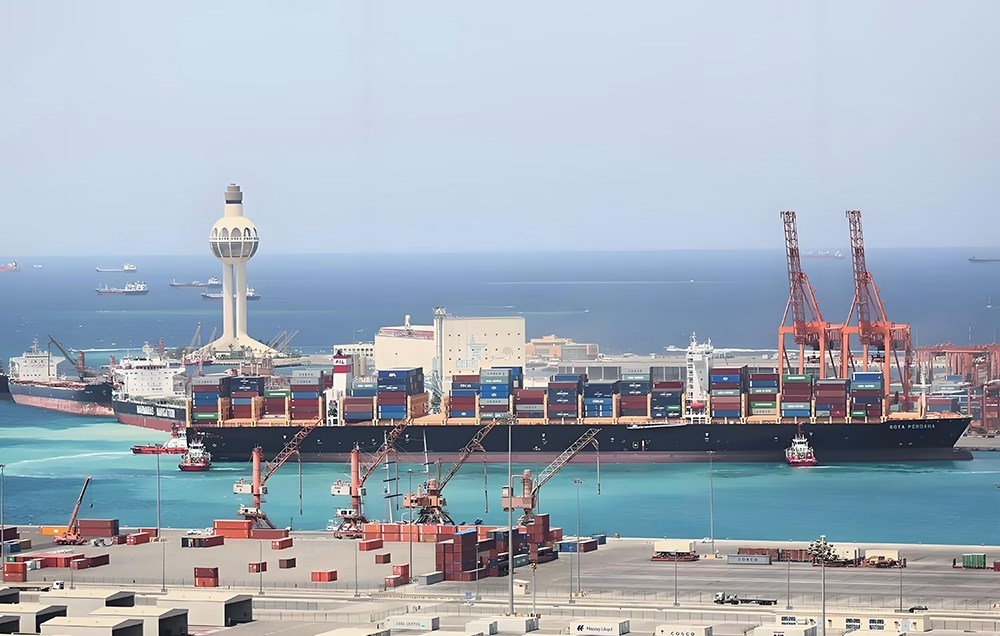
Transit Time: Approximately 20–30 days from major Chinese ports (e.g., Ningbo, Shanghai, Tianjin) to Jeddah or Dammam in Saudi Arabia
For new energy vehicles, we often ship with compatible DC fast chargers, and we support charging port conversions (e.g., from GBT to CCS2) to meet Saudi Arabia’s CCS2 charging standards.
3. Saudi Customs Clearance Procedures
Upon arrival at Jeddah or Dammam port, the importer must complete the following:
Required Import Documentation
Original or Telex Release Bill of Lading
SASO-COC Certificate
Commercial Invoice (including CIF value)
Packing List
Certificate of Origin (COO)
Arabic Labeling: The vehicle nameplate must include both Arabic and English, with clear VIN and engine number
Importer’s CR (Commercial Registration): The Saudi consignee must hold an active commercial license
Tax and Duty Overview
Import Duty for Gasoline Vehicles: Ranges from 5% to 20%, depending on engine displacement
Electric Vehicles: Currently exempt from import duty
Value Added Tax (VAT): 15% of the CIF (Cost + Insurance + Freight) value
Tip: Work closely with a licensed Saudi customs broker to calculate CIF valuation correctly and avoid under-declaration penalties.
Physical Inspection
Saudi Customs reserves the right to perform rigorous inspections. Any discrepancy between physical vehicles and document specs (such as VIN, chassis, trim level, or powertrain) can result in:
Immediate detention
Delays in clearance
Additional demurrage and port storage fees
4. Risk Management and Tips for a Smooth Export Process
Best Practices for Successful Clearance
Start SASO-COC and energy efficiency certification processes early (minimum 90 days before shipment)
Label all vehicles with dual-language nameplates (Arabic and English)
Use trusted inspection agencies approved by SASO, such as TÜV, SGS, or Intertek
Partner with experienced freight forwarders and Saudi customs brokers
Common Pitfalls to Avoid
Last-minute documentation mismatches (VIN or engine number errors)
Shipping NEVs without proper charger compatibility
Submitting expired or incomplete SASO certificates
Relying on post-shipment documentation correction — not accepted in Saudi clearance
Auto From China: Your Trusted Export Partner to Saudi Arabia
At Auto From China, we provide end-to-end automotive export services for clients across the Middle East, including Saudi Arabia.
Whether you are importing any car brands, we ensure:
SASO/COC documentation handling
Charging port modification (GBT to CCS2)
OEM auto parts sourcing
Fast shipping to Jeddah and Dammam
Customs broker referrals and after-sales consultation
We also supply DC fast chargers, CCS2-to-GBT adapters, and spare parts to support dealerships and EV infrastructure operators in the Gulf region.
Contact Us
Looking to import EVs or PHEVs to Saudi Arabia?
Contact Auto From China today to get a detailed quotation, port delivery plan, and certified export support from China’s leading NEV sourcing platform.