Plan the next buying step
Use this earlier article as background. Confirm current requirements with the destination authority or agent for the exact product, importer and route. The country EV import-guide directory is a starting point for passenger-EV enquiries; parts, machinery and other vehicle categories require their own assessment.
Keep the shipment scope explicit with the customs clearance and vehicle approval checklist. Have the destination assess the actual vehicle specification and approval route separately from customs release before scheduling road use.
Request a destination-specific sourcing and shipping quotation with the product identity, quantity and delivery scope.
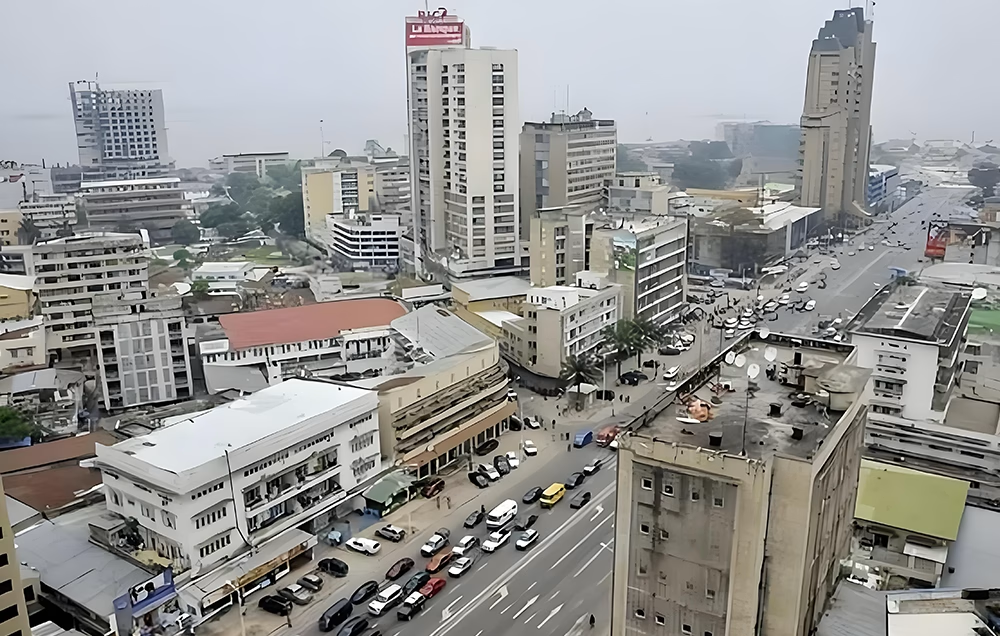
As the demand for cars continues to spike across Africa, Congo has become one of the fastest, albeit chaotic, markets for vehicle exports from China. Despite their differences so far as the automotive industry is concerned, the rapidly expanding consumer markets, infrastructure building projects and the fact that Congo, and more specifically Republic of Congo and the Democratic Republic of Congo (DRC) should be lucrative places for Chinese auto makers, dealers and logistics companies to get involved.
Yet shipping cars to Congo is not straightforward, you need to be well prepared, have the right documents and to know how local customs work. This playbook provides the complete A-to-Z process, from certificates needed, to taxes, to logistics details, and risk-minimizing activities.
1. Pre-Export Preparation: Regulatory Compliance and Documentation
Before shipping vehicles to Congo, Chinese exporters must ensure that all regulatory documents are prepared correctly. Missing or non-compliant paperwork can result in shipment delays, penalties, or even cargo rejections.
Required Export Documents:
Commercial Invoice: Must state the vehicle’s brand, model, engine displacement, VIN, price, and Incoterms (e.g., FOB, CIF).
Packing List: Should match the invoice and include container number, vehicle dimensions, and weight.
Certificate of Origin (COO): Issued by China Council for the Promotion of International Trade (CCPIT). Mandatory for customs clearance and tariff calculation.
Bill of Lading (B/L): Required for all sea shipments. Must match consignee details and be endorsed correctly.
Pre-shipment Inspection Certificate / COC (Certificate of Conformity): Required by Congolese customs, typically issued by third-party organizations like SGS or Bureau Veritas.
Insurance Certificate: Under CIF terms, insurance covering at least 110% of cargo value is required.
Additional Requirements:
Translation: All key documents (invoice, COO, inspection certificates) must be translated into French and officially notarized.
Vehicle Compliance: Congo enforces a minimum emissions standard (Euro 3 or above) and may restrict the import of vehicles manufactured before 2010. Confirmation of vehicle year and mileage is often required.
2. Choosing a Logistics Method: Sea Freight Options
Shipping to Congo is primarily done via sea freight. There are two main delivery ports depending on the destination country:
Republic of Congo: Pointe-Noire Port
Democratic Republic of Congo (DRC): Matadi Port (via Angola) or sometimes through Pointe-Noire with inland transit
Transportation Options:
a) Container Shipping (FCL – Full Container Load)
Suitable for high-value or new vehicles
Better protection against damage or theft
Recommended for small batches or premium models
Standard 40ft container can fit 2–3 SUVs
b) Ro-Ro Shipping (Roll-on/Roll-off)
More cost-effective for bulk exports
Vehicles are driven onto specialized Ro-Ro vessels
Requires operational vehicles and standard dimensions
Estimated Transit Time:
From Shanghai/Shenzhen to Pointe-Noire: 30–40 days (including customs inspection delays)
To Matadi (DRC): 35–45 days, possibly longer if transshipped via Angola
3. Customs Clearance in Congo: Step-by-Step Procedure
Upon arrival at the port, local customs agents or importers must clear the cargo through the Congolese customs system.
Step 1: Port Arrival & Pre-Inspection
Container Seal Check: Authorities inspect container seals and record discrepancies.
Document Submission: Physical copies of invoice, COO, COC, and B/L are presented.
Temporary Import Declaration: Especially for commercial samples or test units.
Step 2: Customs Declaration & Tax Payment
HS Code Declaration: Common code is 8703.x for passenger vehicles
Customs Valuation: CIF value (Cost + Insurance + Freight) is used for tax calculations
Step 3: Applicable Import Duties and Taxes
| Tax Type | Rate |
| Import Duty | 30–35% (based on vehicle type) |
| VAT (Value Added Tax) | 16–18% |
| Customs Processing Fee | ~2% of CIF |
| Vehicle Inspection Fee | USD 100–200 per unit |
⚠️ Tip: Congo customs rely on an internal vehicle valuation database. Under-declared invoices can trigger reassessment and fines.
Step 4: Technical and Safety Inspection
COC Certificate Validation: Checked against vehicle specs
Emissions Testing: Required for compliance with Congolese environmental laws
Odometer Verification: Tampered or unverifiable odometers may lead to confiscation
4. Post-Clearance: Inland Delivery and Registration
Once customs clearance is complete, vehicles can be released for distribution or direct customer delivery.
Trucking: From port to end destination. Inland logistics often pass through challenging infrastructure; 4×4 trucks and local drivers are essential.
Vehicle Registration: Requires presentation of clearance documents and tax receipts. Local registration procedures differ between Brazzaville (Republic of Congo) and Kinshasa (DRC).
5. Key Compliance Tips and Risk Management
Compliance Essentials:
Only import left-hand drive vehicles (right-hand drive imports are restricted)
Avoid vehicles older than 10 years, especially in Kinshasa, where environmental controls are stricter
UN38.3 & MSDS documents are mandatory for EV battery-powered vehicles
Labeling: Vehicles must be equipped with French-language user manuals, tire pressure stickers, and safety warning labels
Risk Mitigation:
Work with licensed local clearing agents
Always pre-book SGS/BV for COC inspections before shipment
Include port congestion and rainy season delays in scheduling
Purchase marine insurance covering political risks (especially for DRC)
Final Thoughts: Why Work With Auto From China?
Auto From China offers comprehensive support for automotive exports to Congo and other African markets. Whether you’re shipping fuel vehicles, electric cars, or fleet equipment, we ensure:
Pre-shipment COC preparation
VIN compliance checks and documentation review
Customized shipping solutions (container or Ro-Ro)
Direct access to reliable clearing agents in Pointe-Noire and Kinshasa
Looking to expand into Congo’s growing automotive market? Contact Auto From China today for a detailed quotation, documentation checklist, and logistics plan tailored to your shipment.