
A negotiated vehicle invoice is evidence of the purchase, but it is not the only input Ghana Customs may use to assess a car. Importers comparing China offers need to distinguish the seller’s payment price from the valuation used for import charges.
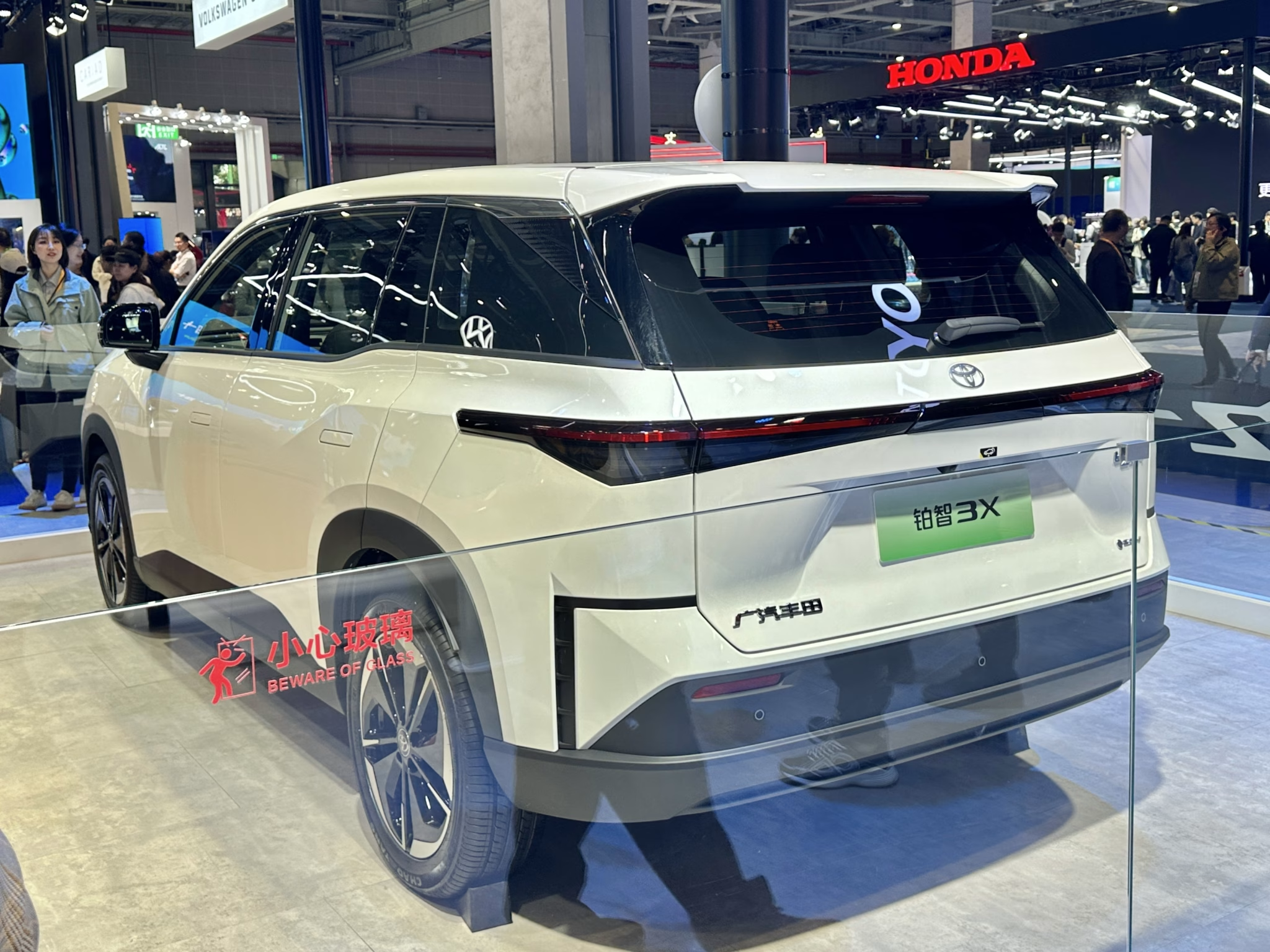
That distinction becomes particularly important for a new Chinese model, a recently registered car or a trim whose local reference is unclear. A low advertised price should not be multiplied by a generic “total tax percentage” and treated as a confirmed clearance budget.
Build the ICUMS identity file first
The Ghana Revenue Authority’s vehicle importation guidance identifies VIN, make, model and year for checking likely duty in ICUMS. It also describes a valuation process referring to the manufacturer’s original price, age-related depreciation, exchange rate, freight and insurance.
For an EV, give the agent the original model code and battery or drive configuration where those distinguish the vehicle. A translated commercial name may conceal different trims. Include the registration history when applicable; “unused” and “never registered” are different statements.
| File item | What it establishes | Error to avoid |
|---|---|---|
| VIN and vehicle plate photos | Exact identity | Submitting only a brochure name |
| Model year and manufacture evidence | Relevant age and version | Using the invoice date as manufacture date |
| Original configuration sheet | Battery, drivetrain and equipment | Pricing a different trim as the reference |
| Invoice and payment evidence | Actual transaction | Treating a promotion as the full contractual price |
| Freight and insurance documents | Transport inputs | Including costs twice or omitting them |
| Registration or title record | Prior status where applicable | Assuming low mileage means a new customs status |
Ask the agent to explain how the proposed vehicle maps to the valuation reference and to retain the supporting calculation. A model that is absent from a familiar lookup list deserves clarification before loading, not an invented substitute entry.
Read 2026 VAT from the current reform guidance
Some older tax tables remain visible online. For the current VAT structure, GRA’s VAT reform explanation states that the new regime took effect on 1 January 2026 under Act 1151: VAT is 15%, NHIL 2.5% and GETFund 2.5%, applied to the same relevant base, with the COVID-19 levy abolished.
That describes the VAT package, not a universal 20% all-in vehicle import charge. Customs duty and other applicable amounts still require separate treatment. The base must be established under the current rules, including relevant non-deductible taxes and levies where required.
An illustrative taxable base of GHS 100,000 produces GHS 15,000 VAT, GHS 2,500 NHIL and GHS 2,500 GETFund: GHS 20,000 combined. This arithmetic uses an assumed base. It does not establish that a car with a GHS 100,000 invoice has that import tax base.
Keep valuation and tax sensitivity separate
Consider two hypothetical scenarios in which the relevant VAT-package base is GHS 100,000 or GHS 120,000 after the full assessment process. At the stated combined 20% arithmetic, the difference is GHS 4,000. Any changes to duty or other bases must be calculated separately.
This comparison shows the cash consequence of valuation uncertainty without pretending to predict the assessment. Ask for a dated broker worksheet with the exchange rate, customs value, each charge and the supporting basis. Place terminal, shipping-line, agent and inland delivery costs below the tax calculation as separate items.
For a VAT-registered dealer, possible input credits and their conditions are a further question. Even where a credit is available, the cash may need to be paid before recovery. Do not subtract a theoretical credit from the amount required to release the car without modelling that timing.
Do not assume every private EV receives policy relief
Ghana’s transport policy promotes electrification, but a policy objective or a public-transport incentive is not proof of a blanket private-car exemption. Require the applicable legal provision and confirmation that the importer, vehicle and use qualify.
Likewise, lawful clearance is only one stage. Registration, charging compatibility and warranty support remain part of the delivered cost and ownership decision.
Request a valuation-ready vehicle offer
Send the Ghana destination, importing entity and preferred configuration through our contact page. Ask for the identity and specification file before obtaining an ICUMS estimate, and use the Ghana import guide with a pre-shipment inspection to keep the purchase and clearance records aligned.