
A 22 kW wall charger does not make every electric car charge at 22 kW. The vehicle’s onboard charger converts AC supply into DC for the battery, and its supported phases and power can limit the session before the wall unit reaches its rating.
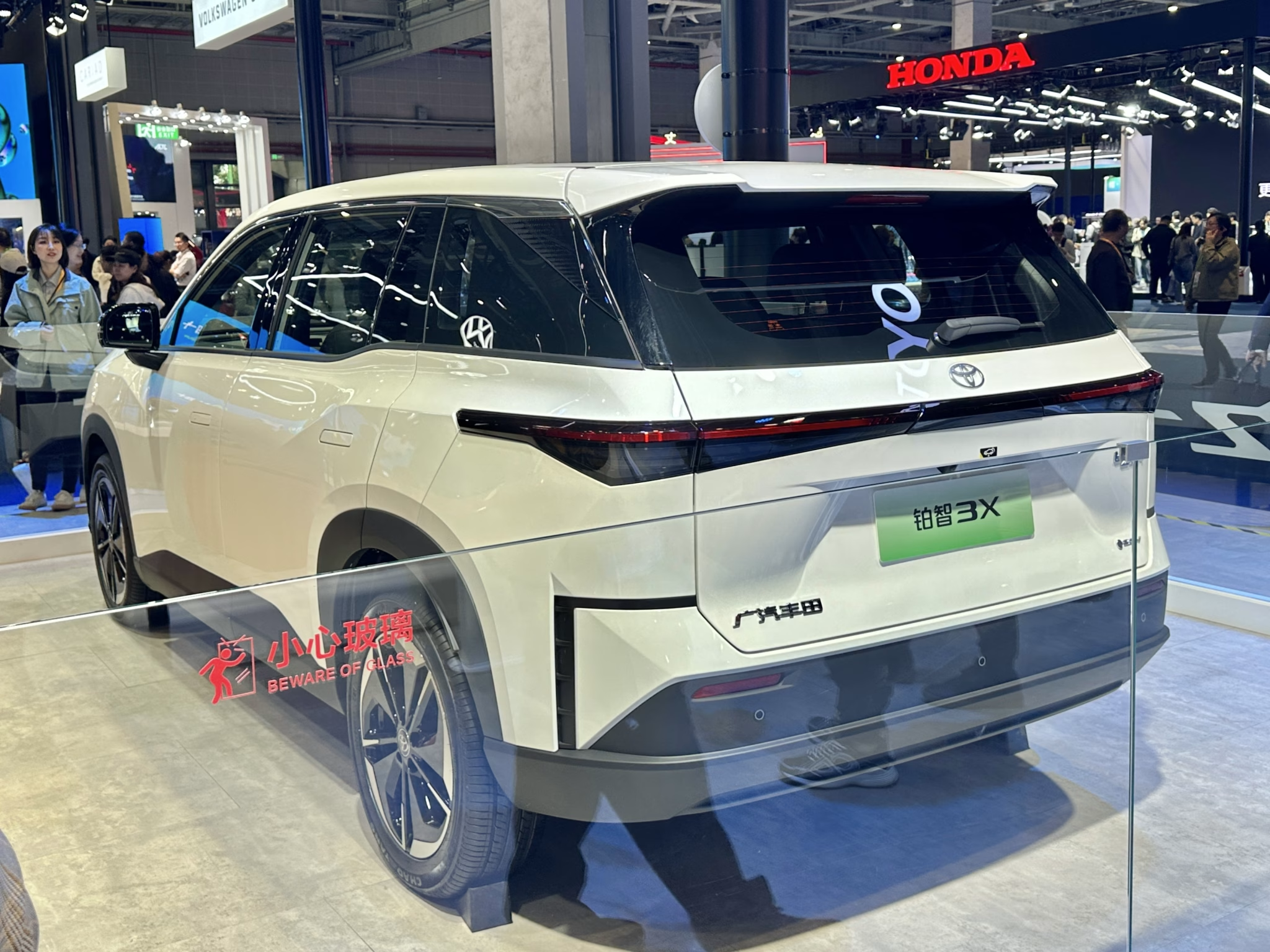
For an imported China-market EV, obtain the AC charging specification for the exact version. Keep that separate from the vehicle’s advertised DC fast-charging power. Buying a larger wall unit without this distinction can add cost without reducing the car’s overnight charging time.
Understand what the equipment rating describes
The U.S. Department of Energy’s Alternative Fuels Data Center identifies vehicle internal-charger capacity, charging equipment and electrical-service specifications among the factors affecting charge time. Its North American connector and electrical examples are regional; they should not be copied as installation rules for another country. Read the charging equipment overview.
For a common 230/400 V planning example, the approximate electrical powers below follow from voltage and current. They assume suitable equipment, the stated voltage, balanced three-phase operation where applicable and power factor near one; they are not installation instructions.
| Example AC arrangement | Approximate power | Important limitation |
|---|---|---|
| 230 V single-phase, 32 A | 7.36 kW | Vehicle and supply must support that single-phase current |
| 400 V three-phase, 16 A per phase | 11.1 kW | Vehicle must accept the relevant three-phase input |
| 400 V three-phase, 32 A per phase | 22.2 kW | A car with a lower onboard limit will not use all this power |
The single-phase estimate is voltage multiplied by current. The balanced three-phase estimate uses the square root of three multiplied by line-to-line voltage and current. Actual battery energy gained will be lower than an ideal calculation because of losses and auxiliary loads.
Compare the car and the parking window
Suppose a vehicle needs 24 kWh added to the battery after its daily route. Use an illustrative AC-to-battery efficiency of 90%, not a guaranteed value for any car. Approximate charging time is energy needed divided by the product of AC power and efficiency: time = energy / (AC power × efficiency).
At 7.36 kW, that gives about 3.62 hours. At 11.1 kW, it gives about 2.40 hours. The higher figure is useful only if the car and site can sustain it. For a car limited to roughly 7 kW AC, purchasing a 22 kW station does not create a 22 kW charging session.
If parking lasts eight hours, both supported options may meet the routine requirement. If parking lasts two hours, neither planning example provides the stated battery energy within the window. The answer may be a changed operating schedule or suitable DC charging, rather than a different AC label.
Single-phase capability needs its own line in the order
A three-phase-rated car or charger can have a different maximum on single-phase supply. Obtain the manufacturer’s documented input limits rather than dividing the three-phase rating or assuming the full rating is available on one phase.
Ask the receiving site for available voltage, frequency, phases and spare capacity, assessed by a qualified electrical contractor. Other site loads, protection, earthing, local permits and charging-equipment approval belong in the installation assessment. A photograph of a convenient socket does not establish a suitable continuous charging supply.
Plan a fleet as a site, not a collection of wall units
Ten nominal 7.36 kW chargers could request about 73.6 kW before considering other loads. A site with 40 kW of available charging capacity cannot sustain that total simultaneously. Managed charging may distribute power over the parking period, but each vehicle still needs enough delivered energy before departure.
Separate installed charger capacity from available site capacity and actual vehicle acceptance. Record priority vehicles, departure times and the energy each needs. This makes load-management settings an operational decision with a measurable outcome.
Verify the delivered arrangement
The acceptance record should identify the car, AC equipment, supply conditions, session duration and energy delivered. Test the arrangement the customer will use. A successful DC demonstration at the export warehouse does not verify AC operation at the destination.
Include the correct cable or connection arrangement, its documented rating and local compatibility in the supply scope. Equipment that works electrically still needs the applicable local approval and installation.
Choose the charging scope alongside the vehicles
Send the vehicle configuration, daily distance, parking hours and assessed supply details to our EV Charging service. We can compare an AC plan with the procurement requirements and vehicle sourcing proposal, keeping site installation responsibilities explicit.
Technical reference reviewed on 9 October 2026. All numerical examples are planning calculations with stated assumptions; final equipment and installation must follow manufacturer instructions and local requirements.