
A Chinese car advertisement may show a manufacturer’s guide price, a dealer discount, a trade-in benefit or a finance-dependent payment. Those figures answer different questions. An overseas buyer needs the price of a specified vehicle that can be supplied through the agreed export route, with clearly defined services.
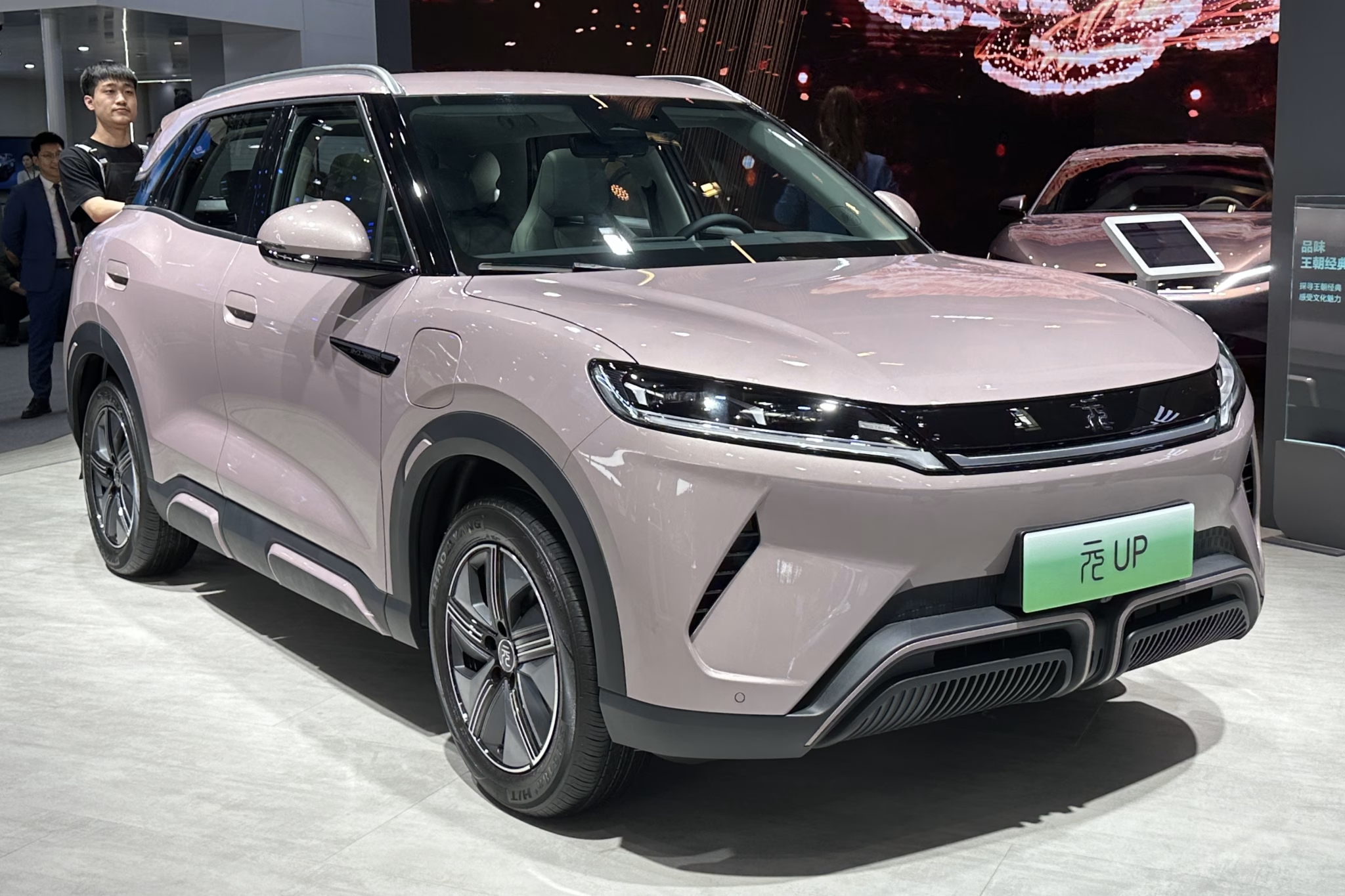
The gap is not automatically an exporter’s margin. It may reflect benefits the overseas order cannot claim, a different configuration or services absent from the domestic advertisement. A useful comparison starts by reconstructing the advertised offer.
Identify the price before converting the currency
Chinese listings often distinguish 指导价, manufacturer’s guide price, from a transaction offer. Terms such as 置换补贴, trade-in subsidy, and 金融优惠, finance incentive, describe conditions rather than equipment discounts available to everyone.
For 2026, MOFCOM’s national trade-in guidance sets eligibility conditions involving an individual consumer, an eligible old vehicle and new-vehicle purchase and registration records. It also specifies supporting documents and restrictions during application review. An overseas invoice is not enough to demonstrate entitlement. Read the original subsidy questions and answers.
Treat a domestic subsidy as unconfirmed for an export order unless the lawful eligibility and actual treatment are established. Do not deduct a headline amount from the vehicle price merely because it appears on a dealer poster.
| Advertised item | What to establish | How to compare it with an export offer |
|---|---|---|
| Manufacturer’s guide price | Exact model year and grade | Reference for that configuration, not proof of stock price |
| Dealer discount | Stock, customer and payment conditions | Count it only if offered for the actual export transaction |
| Trade-in or scrappage benefit | Applicant and vehicle eligibility | Keep it outside the base comparison until verified |
| Finance benefit | Deposit, loan cost, duration and restrictions | Compare total payable amount, not monthly instalment |
| Gifts or credits | Transferability and destination usability | Value them only where the buyer can use them |
A worked comparison of two apparently different prices
The following figures are invented for illustration and are not a vehicle quotation. Assume a car has a reference price of RMB 150,000. A dealer advertisement shows RMB 132,000 after a RMB 8,000 unconditional discount and a RMB 10,000 conditional trade-in benefit.
If the export purchaser does not qualify for that trade-in benefit, the comparable vehicle starting point is RMB 142,000, provided the RMB 8,000 discount is genuinely available. Now assume the export offer adds RMB 4,500 for specified preparation and documentation and RMB 2,000 for inland transport to the named handover point. The resulting example is RMB 148,500 before any further services or costs outside that scope.
Comparing RMB 132,000 directly with RMB 148,500 would suggest a RMB 16,500 gap. After separating the conditional benefit and the stated services, that interpretation changes. The buyer still needs to judge whether the charges are reasonable, but can do so against a consistent scope.
Do not deduct VAT or assume an export tax rebate without evidence of the applicable transaction. A supplier’s tax treatment is not a generic discount formula the buyer can apply to every domestic invoice.
Compare the physical car and the delivery obligation
Check battery, drive layout, seats, wheels and factory options. A cheaper base grade can look identical in a photograph while omitting equipment important to the buyer. A promotion may also apply only to a production batch, registration status or stock colour.
Then compare the trade term and named location. A warehouse price, a port handover price and a CIF destination-port quotation cover different obligations. Destination customs, registration, local delivery and charging equipment should be identified separately where they are outside the offer.
Avoid charging the same expense twice. If inland transport is included in a quoted vehicle package, do not add it again as a logistics line. If inspection is optional, confirm whether the comparison assumes that inspection in both offers.
Keep the price evidence usable
Save the dated promotion, its full conditions and the configuration reference. Ask the supplier for quotation validity, allocated stock status, currency and payment milestones. A screenshot of last month’s campaign should not become today’s stock commitment.
For a dealer order, repeat the comparison per configuration. A blended “average car price” can conceal a few heavily discounted units and several higher-cost versions. Confirm quantities and VIN allocation before relying on the batch total.
Send the complete offer for comparison
Through our quotation enquiry, send the model, destination, quantity and the complete advertised offer with its conditions. We can prepare an itemised sourcing scope alongside the export cost checklist.
Source review: 9 October 2026. The numeric example is an original explanation of price comparison, not a statement of current vehicle pricing, subsidy entitlement or tax treatment.